

Before & After Gallery
Imagining how you will look after surgery can be difficult. To help here are some photos of real patients before and after the procedure. These patients have given written permission for photos to be used.
Frequently Asked Questions
Why Did My Scar Heal Poorly?
Poor scar quality generally falls into a few different categories.
Hypertrophic scars are abnormally thick, and often reddened. This is relatively common, and the most common reason for scar revision. With hypertrophic scarring in the scar may be wide, thick, or both; however, the scars do not grow outside of the original borders of injury. Hypertrophic scars have many causes, including infection, wound healing problems after injury, wounds that are allowed to heal on their own without surgical closure, and genetic causes. These are more common in certain areas of the body than others. Improvement can generally be obtained by nonsurgical or surgical intervention. Nonsurgical treatments are better when started early; surgery is best once scars have "matured."
Keloid scars are rare, although hypertrophic scars are often mislabeled "keloid." These scars act like benign tumors, growing outside of their original borders. Keloid scars are most common in the ears, central chest (over the breast bone), and upper arms. Certain races, including Asian and African patients, are more likely to form keloid scars than others. Keloid scars are also often able to be improved significantly, although multiple interventions are most commonly needed to produce an optimal scar appearance. These interventions include removal of the scar, steroid injection, and pressure application.
Other presentations of poorly healing scars include depressed scars, with an indented appearance; widened scars without additional thickness; and darkened scars a, sometimes caused by sun exposure after injury. Each of these appearances can be improved with surgical or nonsurgical intervention.
What techniques are available to improve scars?
Proven nonsurgical interventions to help existing scars include topical treatments, such as silicone-based therapies (Biocorneum, Mederma, silicone sheeting, etc.), scar massage; minimally invasive procedures such as microneedling, laser treatment, and injection of a local steroid (such as triamcinolone);and application of sunscreen to avoid scar darkening.
Surgical interventions may involve simple removal and reclosure or more advanced maneuvers such as geometric scar rearrangements and tissue advancements. Fat grafting (removal of your own fat through liposuction, purification, and injection into scarred tissue) may also improve the quality of a scar and improve contour of the area of concern.
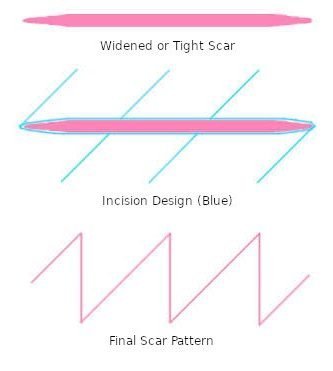
Scar revision may also be functional, to relieve tightness from scarring in certain areas. Some geometric scar rearrangements, such as Z-plasty (see below) can both improve tightness and make a scar less visible because of breaking up the appearance.
How Long Will it Take For My Scar to Reach It's Final Appearance?
Once injury occurs to tissues in the body, a scar forms (the only body tissues that can heal without scars are the liver and bones). How noticeable scars are after surgery or injury depends on many factors, including the location of the injury, how injury occurred (crush injuries, for example, tend to heal worse than cuts), if a wound heals by itself or is surgically closed, and individual healing patterns.
Once a scar has formed, it undergoes a process of change called maturation. During this process the cells and proteins present in the scar change. This typically results in flatter and faded scar appearance, a process which usually takes a year, sometimes longer, to complete. However, the scar may actually appear more red in color and thicker temporarily, and often begins to improve only after two months after injury.